Graphing Quadratic Functions Practice Worksheet
Practice graphing parabolas using vertices, axes of symmetry, intercepts, and completed graph examples.
Try graphing each quadratic function on your own first. Then click Show solution to check the vertex, axis of symmetry, key points, and completed graph.
Key Graphing Ideas
- The graph of a quadratic function is called a parabola.
- The vertex is the turning point of the parabola.
- The axis of symmetry is the vertical line through the vertex.
- If \(a>0\), the parabola opens up. If \(a<0\), it opens down.
Level 1: Vertex Form
Problem 1
Graph the quadratic function.
Show solution
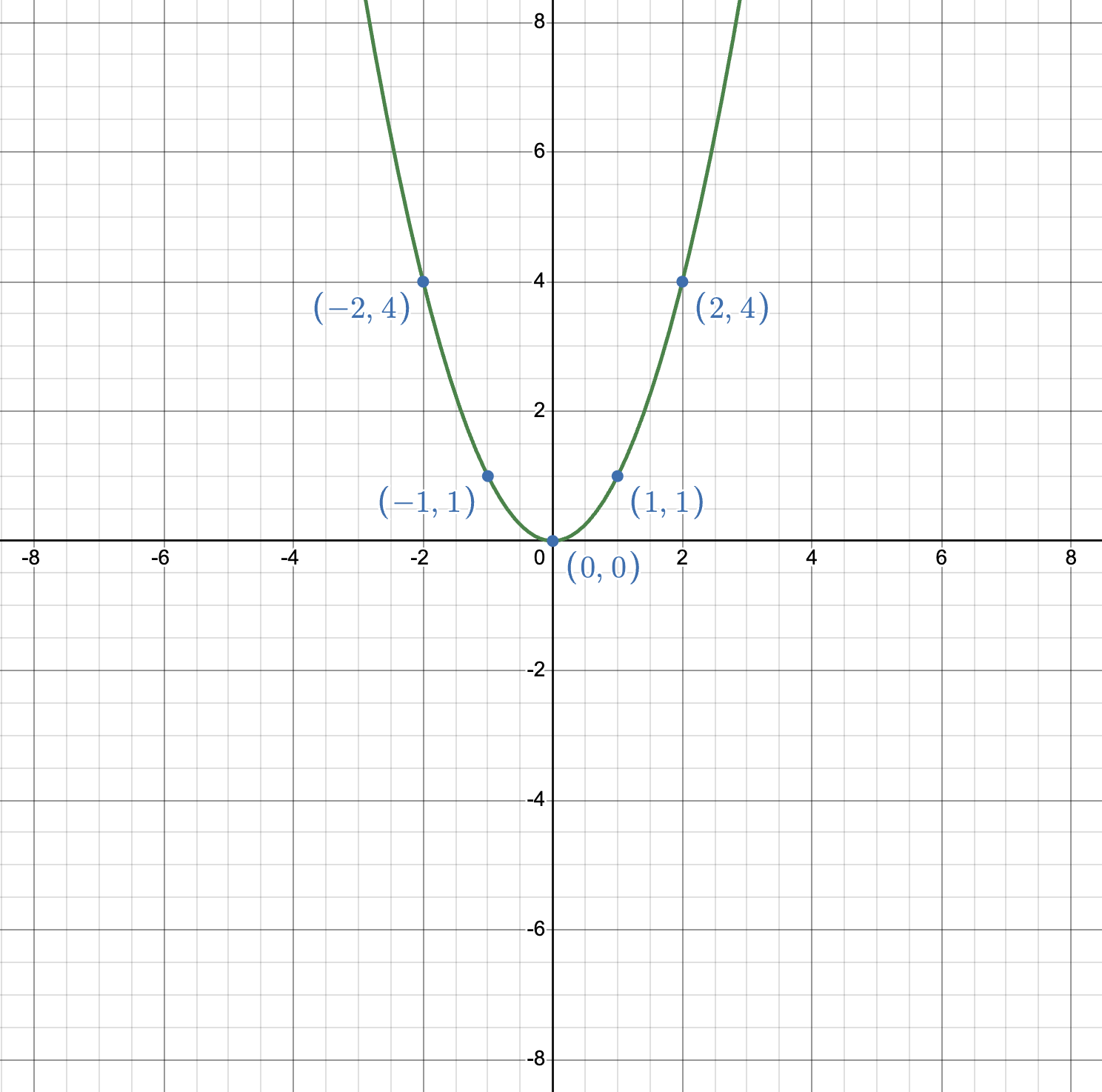
This is the parent quadratic function. The vertex is \((0,0)\), and the axis of symmetry is \(x=0\).
Key points:
\[ (-2,4),\ (-1,1),\ (0,0) \]
\[ (1,1),\ (2,4) \]
Problem 2
Graph the quadratic function.
Show solution
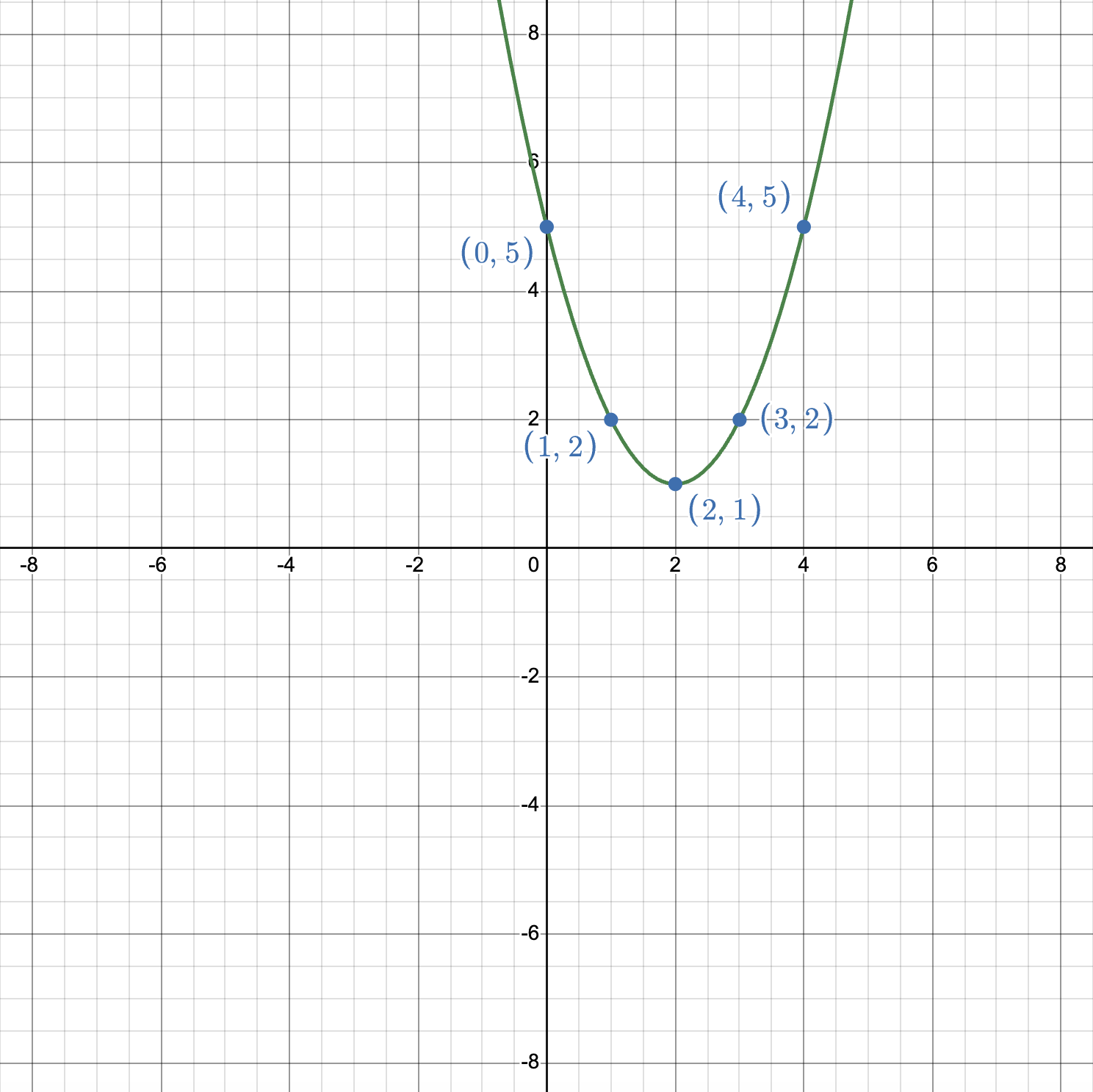
This function is in vertex form.
The vertex is \((2,1)\), and the axis of symmetry is \(x=2\).
Key points:
\[ (0,5),\ (1,2),\ (2,1) \]
\[ (3,2),\ (4,5) \]
Problem 3
Graph the quadratic function.
Show solution
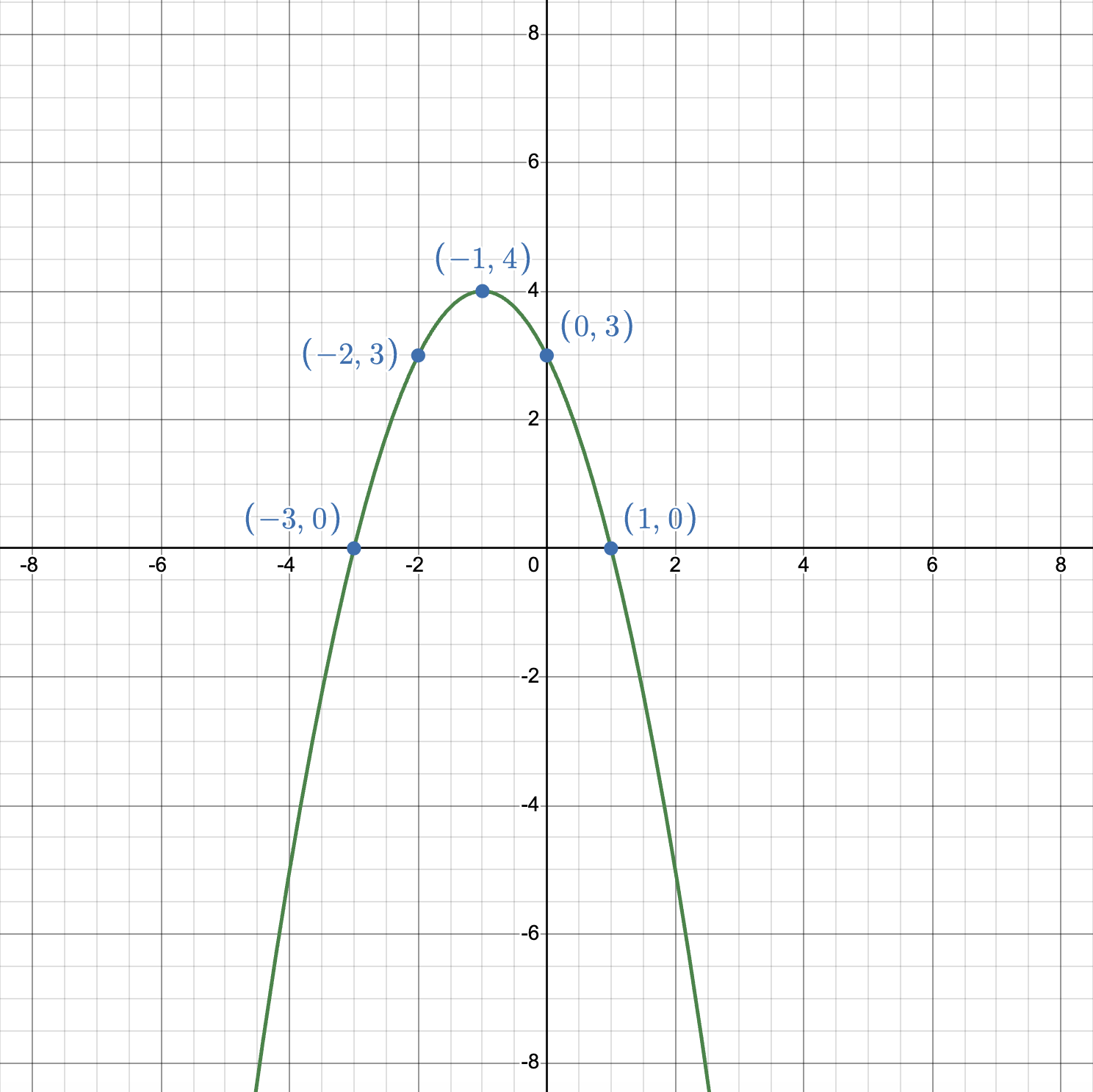
The vertex is \((-1,4)\), and the parabola opens downward because the coefficient is negative.
The axis of symmetry is \(x=-1\).
Key points:
\[ (-3,0),\ (-2,3),\ (-1,4) \]
\[ (0,3),\ (1,0) \]
Level 2: Standard Form
Problem 4
Graph the quadratic function.
Show solution
Find the vertex using:
Here \(a=1\) and \(b=-4\), so:
Substitute \(x=2\):
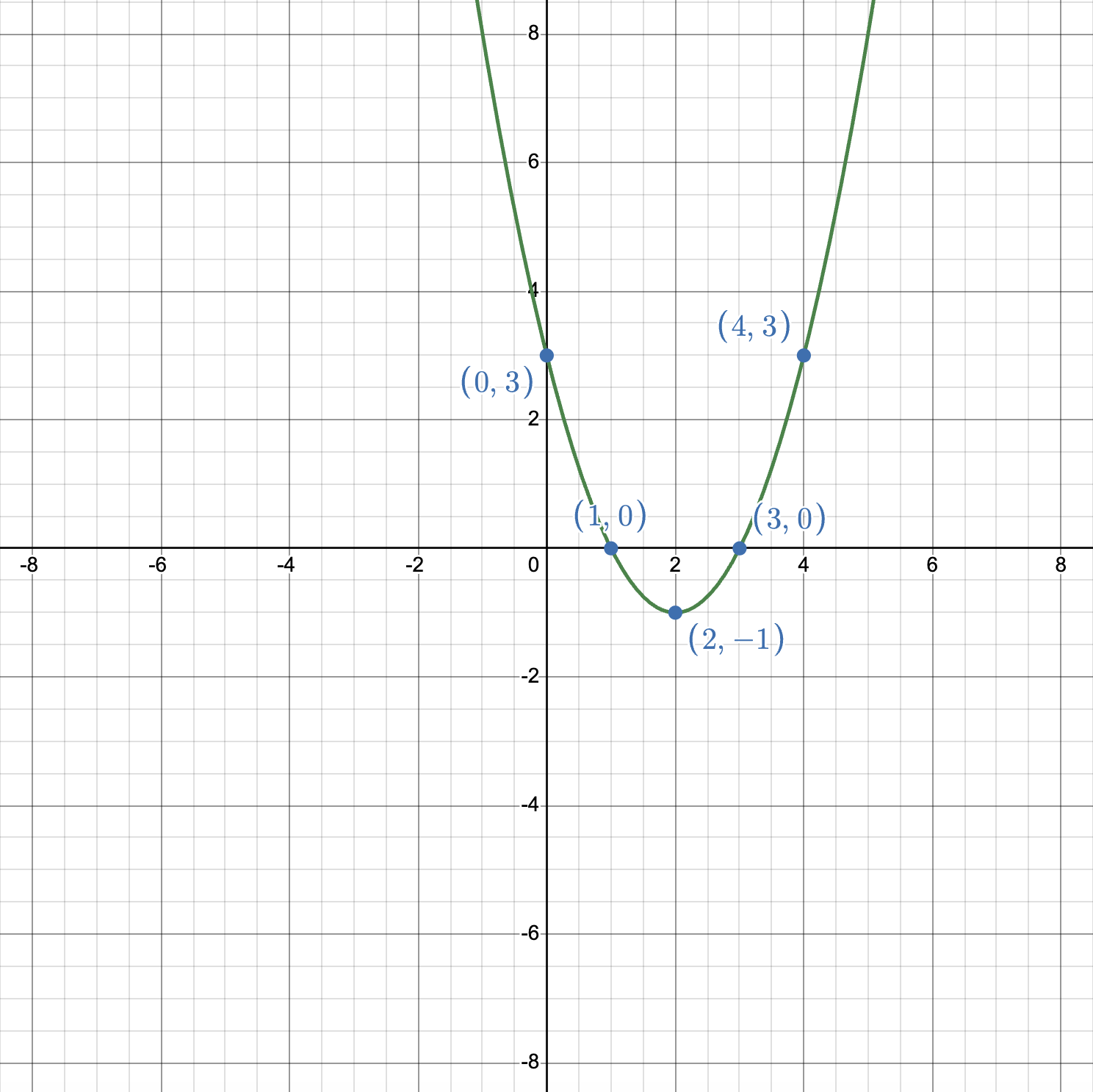
The vertex is \((2,-1)\), and the axis of symmetry is \(x=2\).
Since \(y=x^2-4x+3=(x-1)(x-3)\), the \(x\)-intercepts are \((1,0)\) and \((3,0)\).
Problem 5
Graph the quadratic function.
Show solution
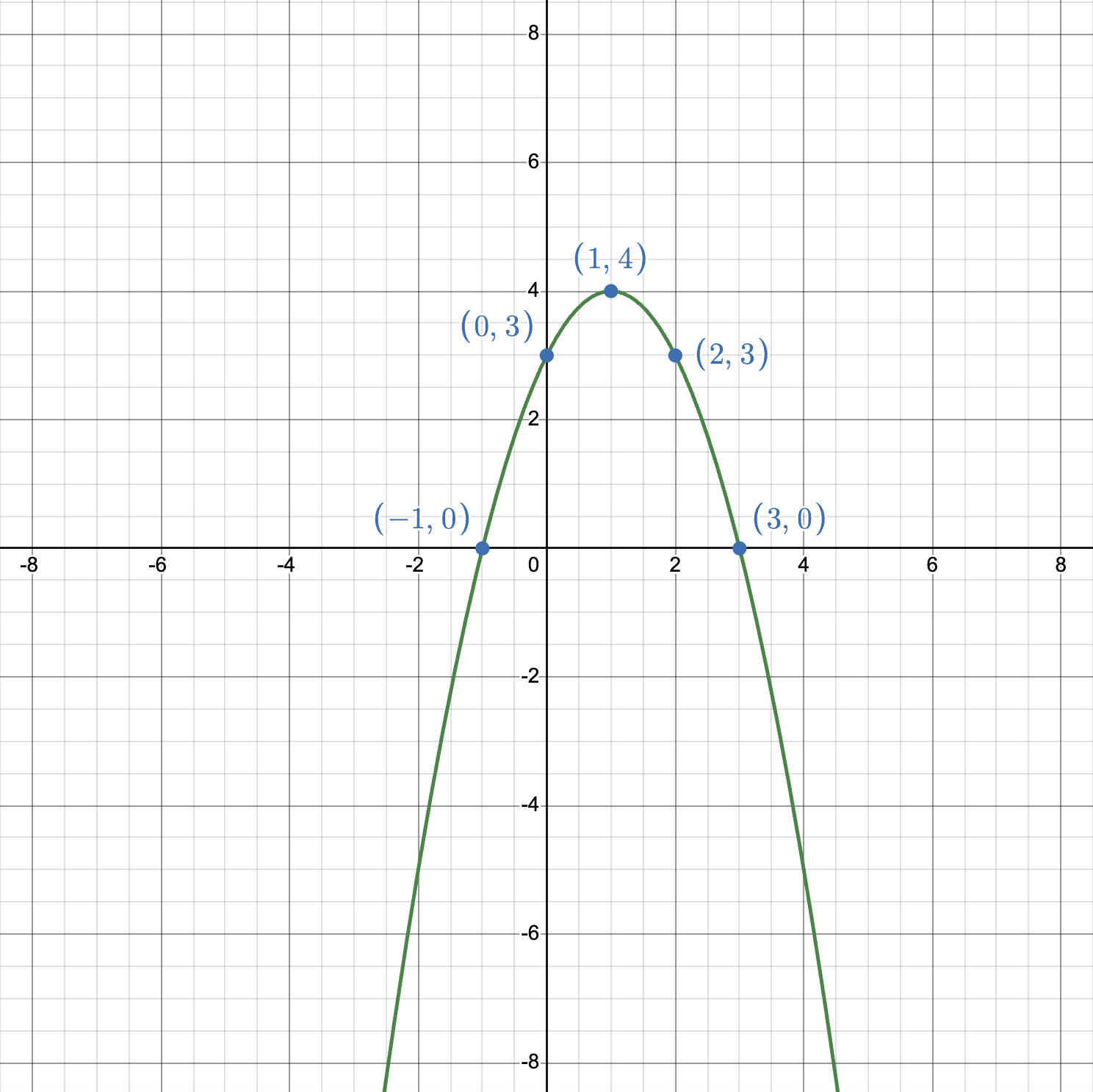
Here \(a=-1\) and \(b=2\).
Substitute \(x=1\):
The vertex is \((1,4)\), and the axis of symmetry is \(x=1\). The parabola opens downward.
Factoring gives:
So the \(x\)-intercepts are \((-1,0)\) and \((3,0)\).
Need more help with graphing quadratics?
Graphing quadratics becomes easier when you can identify the vertex, axis of symmetry, intercepts, and direction of opening. For a full explanation, visit my graphing quadratic functions guide.